
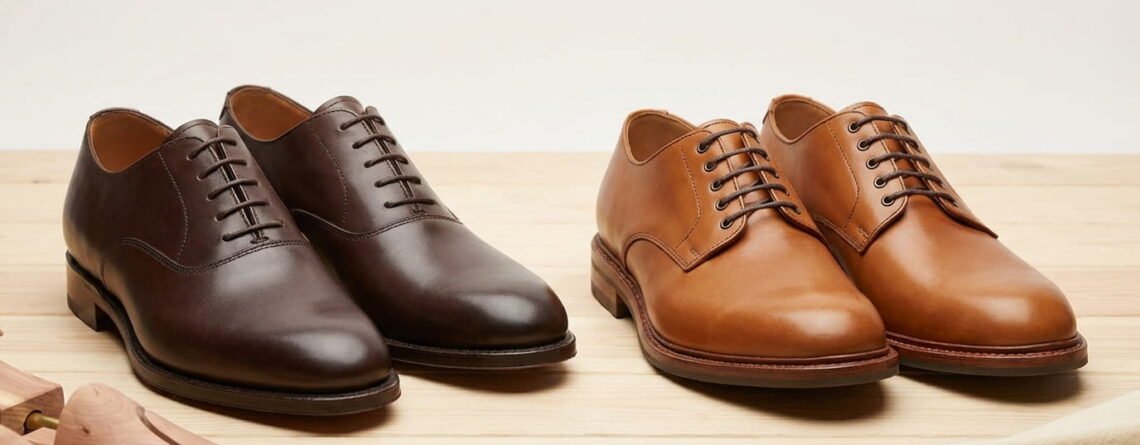
Oxford and Derby shoes look similar at first glance — both are lace-up leather shoes that work in formal and professional settings. But there is one key structural difference between them, and that difference changes everything about when and how you wear each one. This guide explains exactly what sets them apart, which one suits which occasion, and how to decide which is right for you.
The One Difference That Matters Most
Before anything else, it helps to understand the single structural detail that separates an Oxford from a Derby. Everything else — formality, versatility, styling — follows from this one point.
On an Oxford, the lacing system is closed. The two panels of leather that the laces thread through — called the quarters — are sewn underneath the front panel of the shoe (the vamp). This means the lace eyelets sit close together with almost no gap between them, giving the shoe a clean, tight, sleek profile.
On a Derby, the lacing system is open. The two quarter panels are sewn on top of the vamp, which means the top of the shoe can open more widely when unlaced. The eyelets sit further apart and the gap between them is visible and wider.
The Oxford Shoe — Everything You Need to Know
The Oxford
⭐ Most FormalThe Oxford is widely considered the most formal lace-up leather shoe in existence. Its closed lacing system gives it a smooth, uninterrupted line across the front of the shoe that looks clean and sharp under trousers. When laced, the shoe hugs the foot closely and the top lies completely flat — there’s no visible gap, no spreading, no looseness.
This sleek, closed appearance is exactly what makes Oxfords the traditional choice for formal occasions — black-tie events, important business meetings, weddings, and any situation where the standard of dress is high. A well-polished pair of black Oxford shoes remains the single most formally correct lace-up shoe a man can wear.
The tradeoff is fit flexibility. Because the quarters are stitched down, the shoe cannot open very wide. If you have wider feet or a high instep, getting an Oxford on and off can be less comfortable — and if the fit isn’t right, it’s harder to adjust. Once laced, the fit is firm and precise, which suits narrower and medium-width feet well but can be restricting for wider feet.
✔ Strengths
- The most formally correct lace-up shoe
- Clean, sleek profile under suit trousers
- Looks sharp and precise in formal settings
- Timeless — never goes out of style
- Polishes to an exceptional mirror shine
✘ Limitations
- Less versatile than a Derby for casual wear
- Less accommodating for wide or high-instep feet
- Can feel too formal for smart-casual settings
- Harder to put on and take off
- Looks out of place with jeans
The Derby Shoe — Everything You Need to Know
The Derby
🔵 Most VersatileThe Derby is slightly less formal than the Oxford — but it makes up for that with significantly more versatility. The open lacing system means the shoe can spread wider when being put on and can be adjusted more freely once on the foot. This makes Derbies more comfortable for a wider range of foot shapes and widths, and more practical for all-day wear.
The open quarters also give the Derby a slightly more relaxed visual character. It doesn’t have the same pin-sharp formality as an Oxford — but in most professional and smart-casual settings, that’s actually an advantage. A Derby feels appropriate in contexts where an Oxford might look slightly stiff or overdressed.
Derbies cross the line between formal and casual more easily than Oxfords. A dark brown Derby works perfectly well with a business suit. The same shoe also looks sharp with dark jeans and a blazer on the weekend. This range — from office to casual without changing shoes — is the Derby’s greatest strength and why many style experts consider it the most practical leather shoe to own.
✔ Strengths
- Far more versatile across formality levels
- Better fit flexibility for wider feet
- Easier to put on and take off
- Works with suits, chinos, and dark jeans
- More comfortable for all-day wear
✘ Limitations
- Slightly less formal than an Oxford
- Open lacing can look less sleek under formal trousers
- Not the traditional choice for black-tie events
- Less of a statement shoe in very formal settings
- May look slightly casual in the most formal offices
Oxford vs Derby — Side by Side
| Feature | Oxford | Derby |
|---|---|---|
| Lacing system | Closed — quarters stitched under the vamp | Open — quarters stitched on top of the vamp |
| Formality level | Most formal lace-up shoe available | Smart-formal to smart-casual |
| Versatility | Suits and formal occasions primarily | Suits, chinos, smart-casual, dark jeans |
| Fit flexibility | Fixed — less adjustable, suits narrow feet best | More adjustable — suits a wider range of foot shapes |
| Ease of wear | Harder to put on and take off | Easier to put on and take off |
| Visual profile | Sleek, clean, closed line across the top | Slightly more open, relaxed appearance |
| Best occasion | Formal events, black-tie, important meetings | Office, smart-casual events, everyday professional wear |
| With jeans | Rarely works — too formal a contrast | Works well with dark or indigo jeans |
| If you own one pair | Less practical as a single do-everything shoe | More practical — covers more situations |
| Wide feet | Can be uncomfortable — limited adjustment | Much more comfortable — open lacing accommodates width |
Which One to Wear — Situation by Situation
Black-Tie or Very Formal Events
Oxford WinsFor the most formal occasions — black-tie dinners, formal weddings, gala events — the Oxford is the correct and traditional choice. A black cap-toe Oxford is the benchmark of formal footwear. No other lace-up shoe comes close in these settings. Derby shoes, while smart, simply don’t carry the same level of formal authority.
Business Professional / Corporate Office
Oxford PreferredIn traditional corporate environments — law firms, financial institutions, formal client-facing roles — a black or dark brown Oxford signals precision and attention to detail in a way that Derbies don’t quite match. That said, a well-polished dark brown Derby is entirely appropriate in most modern professional offices and is worn confidently by professionals globally. Oxford is the traditional choice here; Derby is a perfectly acceptable alternative.
Modern Office and Business Casual
Derby WinsIn most contemporary office environments — tech companies, creative agencies, modern professional settings — the Derby is the more practical and appropriate choice. It looks sharp with a suit but doesn’t feel stiff or overdressed in less formal surroundings. The Derby’s ability to sit comfortably between formal and smart-casual makes it the ideal everyday office shoe in modern workplaces.
Smart-Casual Events — Dinners, Parties, Dates
Derby WinsFor smart-casual events where you want to look sharp without being overdressed, the Derby is the better choice. It pairs effortlessly with chinos, tailored trousers, and dark jeans — giving you a polished look that doesn’t feel like you’ve walked in from a board meeting. A medium brown Derby with navy chinos and a blazer hits exactly the right note for most smart-casual occasions.
Formal Weddings
Oxford PreferredFor formal or traditional weddings where guests are expected to dress formally, an Oxford is the more correct choice — especially in black or very dark brown. For semi-formal or relaxed weddings where the dress code is smart rather than formal, a well-polished Derby is entirely appropriate and slightly easier to wear comfortably through a long day of standing, dancing, and celebrating.
Job Interviews
Either WorksBoth Oxfords and Derbies are appropriate for job interviews in most industries. For very formal sectors — law, finance, government — a black Oxford sends the most traditionally correct signal. For most other industries, a well-polished dark brown or black Derby is equally impressive and demonstrates the same attention to dress. Match the shoe to the industry’s dress norms rather than defaulting to the most formal option regardless of context.
With Jeans
Derby Wins ClearlyA Derby shoe with dark indigo jeans and a blazer is a well-established smart-casual combination. The open lacing and slightly relaxed character of the Derby bridges the formality gap between leather shoes and denim. An Oxford with jeans almost always looks awkward — the formality of the closed-lace shoe clashes with the casual nature of the denim, and the result looks like two different outfits forced together.
Variations to Know Within Each Style
Oxford Variations
Cap-Toe Oxford
The most formal Oxford variation. A clean horizontal seam across the toe cap is the only decoration — everything else is plain leather. This is the shoe worn at black-tie events and the most formal professional settings. A black cap-toe Oxford is universally considered the most formally correct shoe available.
Whole-Cut Oxford
The most minimalist Oxford — the entire upper is cut from a single piece of leather with no seams except at the heel. It’s exceptionally clean and sleek but requires very high-quality leather to look its best. Whole-cut Oxfords are among the most sophisticated shoes available and are usually found only at the premium and luxury end of the market.
Brogue Oxford
A standard Oxford shape with decorative perforations (broguing) along the seams and toe cap. The broguing adds character and reduces the formality slightly — making it appropriate for smart-formal settings but less so for the most formal occasions. A brown full-brogue Oxford is one of the most versatile and attractive shoes in British menswear tradition.
Derby Variations
Plain Derby
No decoration — just the open lacing and clean upper. A plain Derby in black or dark brown sits closest to Oxford formality levels and is appropriate in most professional environments. The simplicity makes it easy to pair with almost anything.
Brogue Derby
A Derby with decorative perforations along the seams and edges. The most popular and widely worn variation of the Derby shoe. A medium brown full-brogue Derby sits firmly in smart-casual territory and works beautifully with suits, chinos, and casual outfits alike. It’s one of the most recognizable and loved shoes in classic British style.
Wingtip Derby
A specific brogue pattern where the toe cap extends in a W-shape toward the sides of the shoe — like a bird’s wings. Common in American traditional style and popular in both formal and smart-casual settings. Wingtip Derbies are especially popular in medium brown and tan leather.
Which One Should You Buy First?
If You’re Buying Your First Quality Leather Shoe — Buy a Derby
The Derby’s versatility makes it the more practical first purchase for most people. It covers professional office wear, smart-casual events, dinners, and can even work with dark jeans — which an Oxford cannot. A dark brown Derby handles 90% of the situations most people encounter.
Once you have a Derby that covers your everyday needs, an Oxford becomes your next investment — specifically for the formal occasions where its precision and traditional authority are genuinely called for. Own both eventually. Start with the Derby.
Frequently Asked Questions
Can a Derby shoe be worn to a formal event instead of an Oxford?
In most formal events — including weddings, formal dinners, and professional meetings — a well-polished Derby in black or very dark brown is entirely acceptable. The formality difference between a plain Derby and a plain Oxford is subtle enough that most people won’t notice. The exception is black-tie events, where an Oxford is the traditional and correct choice. If you only own Derbies and face a formal occasion, wear them polished and well-maintained — a gleaming Derby always beats a scruffy Oxford.
Are Oxfords or Derbies better for wide feet?
Derbies are significantly more comfortable for wide feet. The open lacing system means the shoe can spread more across the top of the foot, accommodating wider feet without pinching. Oxford shoes have a fixed, closed quarter that limits how wide the shoe can open — making them less comfortable for wide or high-instep feet. If you have wide feet, always try Oxfords on very carefully before buying and consider going up a half size or choosing a wide-fit last.
Is it correct to call a Derby shoe a “Gibson”?
Yes — Derby shoes are also known as Gibson shoes, particularly in British English. The two terms refer to the same open-laced shoe construction. “Derby” is the more widely used term internationally, while “Gibson” is more common in traditional British tailoring and shoemaking circles. Both names are correct. You may also occasionally see open-laced shoes labeled simply as “bluchers” — particularly in American English — though technically a blucher refers to a specific American variation of the open-laced construction.
Oxford and Derby shoes each have a clear purpose — and once you understand the difference, choosing between them becomes straightforward. When formality is the priority, reach for the Oxford. When versatility and everyday practicality matter more, the Derby is the smarter choice. Own both eventually, know when to wear each one, and you’ll always have the right shoe for the occasion.


Leave a Reply