
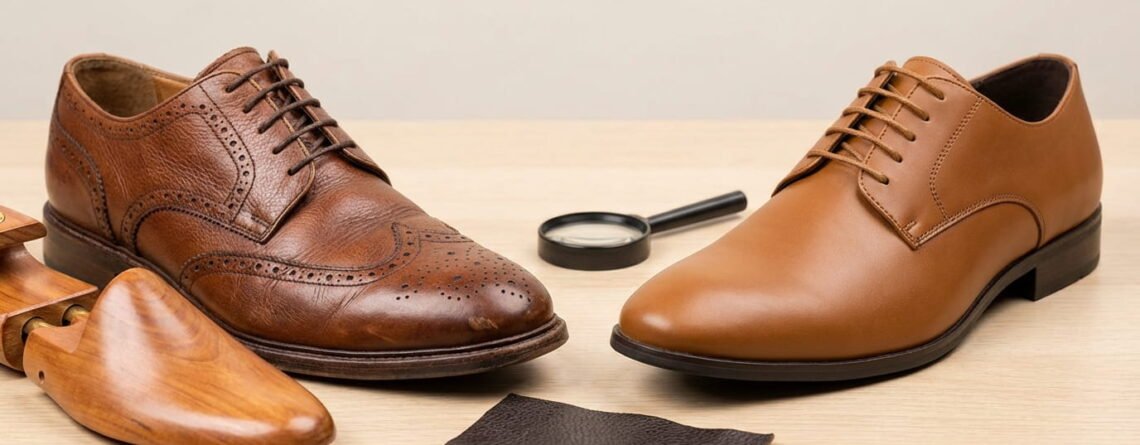
You’ve found a great pair of shoes, but something feels off — are they actually real leather? It’s a fair question, and it matters. Real leather lasts years longer than fake leather and feels completely different on your foot. Here are the easiest and most reliable ways to tell them apart, no experience needed.
Why It Matters to Know the Difference
Fake leather — often called faux leather, PU leather, or bonded leather — can look almost identical to real leather on a store shelf. Brands sometimes use vague words like “leather look” or “premium material” to make fake shoes sound better than they are.
Real leather breathes, molds to your foot over time, and can last 10 to 20 years with proper care. Fake leather tends to crack, peel, and fall apart within a year or two — no matter how well you take care of it.
Knowing the difference helps you spend your money wisely.
Check the Label First
This is the easiest step. Before doing any physical test, look at the shoe’s label, tag, or product description.
Real leather shoes often say:
- Full-grain leather — the highest quality, from the top layer of the hide
- Top-grain leather — slightly sanded, still genuine leather
- Genuine leather — real but lower quality
- Suede or nubuck — real leather with a soft, velvety finish
If the label says “man-made materials,” “synthetic upper,” “PU,” or “vegan leather,” it is not real leather. These are honest terms some brands use — but many don’t label their shoes clearly at all. That’s when the tests below come in handy.
The Touch Test
Real leather has a distinct feel. Run your hand across the surface of the shoe. Real leather will feel slightly warm, soft, and natural — almost like touching skin. It has a subtle give when you press it.
Fake leather, on the other hand, tends to feel cool, smooth, and almost plastic-like. It’s often too uniform and too perfect in texture.
The more you handle real leather, the easier this test becomes. If you can, try comparing a known leather item (like a leather wallet or belt) to the shoes you’re testing.
The Wrinkle Test
This one is simple and very reliable. Press your thumb firmly into the surface of the shoe and bend or push the material slightly.
Real leather will wrinkle and crease naturally — just like your skin does when you press it. The wrinkles will look uneven and organic.
Fake leather will either stay smooth and spring back immediately, or it will crease in a very stiff, unnatural way. Some low-quality faux leather will even show small cracks if bent repeatedly.
Look at the Surface Texture
Real leather has a natural, slightly irregular grain. No two spots look exactly the same. You’ll notice small variations, tiny pores, and a texture that looks organic.
Fake leather usually has a repeating pattern. The grain looks the same across the entire surface — almost like a printed texture. If you look closely and see a perfectly uniform pattern repeating itself, that’s a sign it’s synthetic.
This is easier to spot if you look at the shoe in good lighting, especially natural daylight.
The Edge Test
Turn the shoe over and look at the edges — around the sole, the tongue, or the collar of the shoe (the opening where your foot goes in).
Real leather edges are rough and fibrous. You’ll often see small fibers or a slightly uneven edge, because leather is cut from a hide and has natural layers.
Fake leather edges are usually smooth, clean, and almost plastic-looking. Some faux leather is made by coating fabric with plastic, so the edge will show a fabric backing with a smooth coating on top.
The Smell Test
Smell is one of the most telling signs — and it’s hard to fake.
Real leather has a rich, earthy, natural smell. It’s the kind of smell you notice when you walk into a leather goods shop. It’s slightly musky and warm.
Fake leather smells like plastic or chemicals. It might be faint, but if you bring the shoe close and take a slow sniff, you’ll usually notice a synthetic odor.
This works especially well on new shoes, before any polish or cleaning products have been applied.
The Water Drop Test
Real leather is naturally porous, which means it absorbs a tiny amount of water before repelling it. If you place a small drop of water on real leather, you’ll notice it soaks in slightly before drying.
Fake leather is non-porous. A water drop will sit on the surface and roll right off without being absorbed at all.
You only need one small drop on an inconspicuous area — like the inside of the tongue or a hidden spot near the sole. This test takes about 30 seconds and is very accurate.
The Price Test (as a Clue, Not a Rule)
Real leather shoes — especially full-grain leather — cost money to produce. If a pair of “leather” shoes is extremely cheap, there’s a good chance they’re not made of real leather.
That said, price alone is not a reliable test. Some brands charge high prices for fake leather, and some genuinely good leather shoes are available at mid-range prices. Use price as a clue, not a final answer.
How to Check When Shopping Online
Buying shoes online makes physical testing impossible, so you have to rely on other signals:
- Read the full product description carefully — look for specific leather grades like full-grain or top-grain
- Check the materials section, not just the title or headline
- Look at customer reviews — buyers often mention if the shoes peeled or cracked early
- Look for photos of the shoe’s edges and interior, which show the material more honestly
- Buy from brands with a clear return policy in case the shoes don’t match the description
Frequently Asked Questions
Is bonded leather the same as real leather?
No. Bonded leather is made from ground-up leather scraps mixed with glue and pressed onto a fabric backing. It contains some real leather content, but it behaves more like fake leather — it peels and cracks quickly. It’s the lowest grade of leather and should not be confused with full-grain or top-grain leather.
Can fake leather look just as good as real leather?
Yes, at first glance — especially in photos or store lighting. High-quality faux leather can look nearly identical to real leather. But over time, the difference becomes very clear. Real leather develops a natural patina and gets better with age. Fake leather starts to crack, peel, or look worn out within a year or two of regular use.
Are vegan leather shoes bad quality?
Not always. Some plant-based and high-grade synthetic leathers are improving in quality. But most vegan leather shoes still don’t last as long as real leather. If you prefer animal-free options, look for newer materials like microfiber leather or plant-based alternatives, and check reviews for long-term durability before buying.
With these simple tests, you’ll never have to guess again at the shoe store. Real leather has a feel, a smell, and a texture that fake leather simply can’t copy — once you know what to look for, spotting the difference takes just a few seconds.

Leave a Reply