
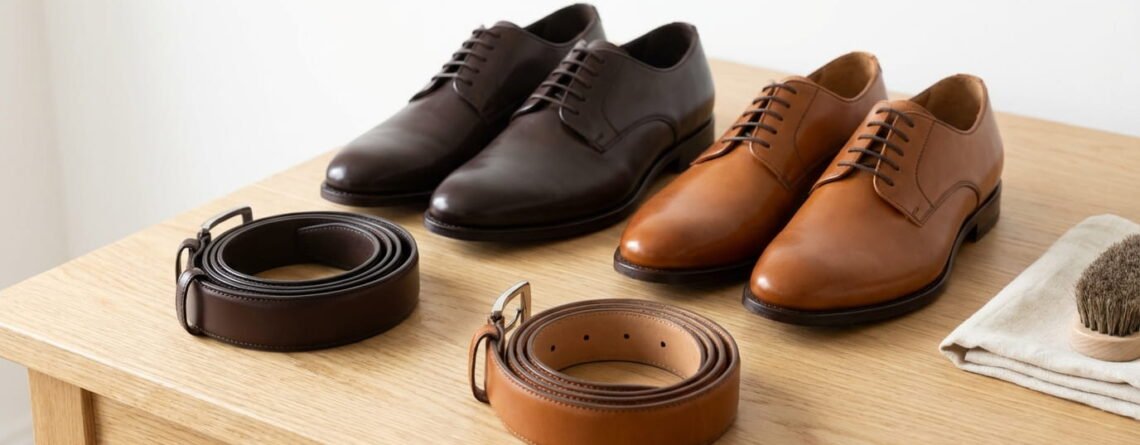
The shoe-belt rule is one of the most talked-about style guidelines in men’s dressing — and also one of the most misunderstood. Most men know they’re supposed to match their shoes and belt, but don’t know exactly what “match” means, when the rule applies, or when they can safely break it. This guide covers everything clearly, so you always know exactly what belt to pair with your leather shoes.
Why the Shoe-Belt Rule Exists
The shoe-belt rule exists for one simple reason: visual coherence. When your shoes and belt are in the same color family, the eye reads the outfit as a complete, intentional whole. When they don’t match, the belt and shoes compete for attention and the outfit feels slightly off — even if the person looking can’t immediately say why.
Your belt sits at your waist and your shoes sit at your feet. These are two of the most visible elements of any outfit. When they’re aligned in color and finish, the entire look between them — your trousers, shirt, and jacket — sits inside a coherent frame. When they clash, that frame is broken and the outfit looks unfinished.
Understanding this principle — not just the rule — is what lets you apply it correctly and bend it intelligently when the situation calls for it.
The Core Rule — Explained Simply
The Rule in One Sentence
In formal and smart-casual settings, your leather belt should match your leather shoes as closely as possible in both color and finish — the same shade of brown, the same black, the same burgundy, and ideally the same level of shine or matte finish.
This rule applies whenever your belt is visible — which means any outfit where you’re wearing a tucked-in shirt, trousers without belt loops covered by a jacket, or any smart or formal outfit where the waistband area is on display.
Matching by Shoe Color — What to Pair With What
Black Shoes
⭐ Easy to MatchBlack shoes require a black belt. There is no flexibility here in formal or professional settings. Black is the most formal shoe color and the rule is at its strictest when formality is highest. A brown belt with black shoes — regardless of how dark the brown — always reads as a mismatch in formal settings.
The only decision with black shoes is the belt’s finish and hardware. A highly polished black leather belt suits dress shoes for formal occasions. A matte or slightly textured black leather belt suits black Chelsea boots or loafers in smart-casual settings.
Dark Brown Shoes (Chocolate / Espresso)
⭐ Match in the Same FamilyDark brown shoes need a dark brown belt. The shade should sit in the same dark range — don’t pair a chocolate brown shoe with a tan or medium brown belt. The contrast between dark brown shoes and a lighter brown belt looks just as mismatched as brown and black together.
One degree of shade difference in the same brown family is acceptable and sometimes unavoidable — finding a perfectly identical match across two different products is difficult. The goal is to stay within the same depth of brown. If both the shoe and belt read as dark brown at a glance, you’re in the right territory.
Medium Brown Shoes (Chestnut / Walnut / Cognac)
⭐ Most Forgiving MatchMedium brown shoes are the most forgiving to match because the middle ground of brown offers a wider acceptable range. A medium brown shoe pairs well with a belt anywhere from slightly lighter to slightly darker in the same warm brown family. That said, don’t go too far in either direction — a medium brown shoe with a nearly black belt or a very pale tan belt still reads as a mismatch.
Cognac shoes pair especially well with cognac or rich chestnut belts. The warm amber tones in cognac leather look best matched with something in a similar warm brown register rather than a cooler chocolate brown.
Tan Shoes (Light Brown / Caramel / Honey)
🔵 Stay LightTan shoes need a tan or light brown belt. Don’t pair tan shoes with a medium or dark brown belt — the contrast between light shoes and a darker belt looks unbalanced and pulls the eye in two directions. A tan belt with tan shoes keeps the warm, relaxed energy of the color consistent from foot to waist.
With tan shoes, the belt hardware matters more than with darker shoes because the overall look is lighter and every detail is more visible. A simple, clean gold or brass buckle looks natural with tan leather. Heavy or ornate hardware can look out of place in the lightness of a tan shoe outfit.
Burgundy Shoes (Oxblood / Wine)
🔵 Match or Go DarkerBurgundy shoes ideally pair with a burgundy leather belt — but burgundy belts are less common than burgundy shoes, so some flexibility is needed here. A very dark brown belt — chocolate or espresso — works reasonably well with burgundy shoes because the deep brown and deep red-brown sit close enough in tone that the pairing reads as intentional rather than mismatched.
What doesn’t work with burgundy shoes is a black belt or a medium brown belt. Black reads as too stark a contrast, while medium brown creates a clash of warm tones that looks unresolved. If you’re investing in burgundy shoes, it’s worth finding a matching burgundy belt — the complete look is significantly more polished than any substitute.
The Three Elements of a Good Match
Color is the most important element of matching shoes and belt — but it’s not the only one. A truly well-matched shoe-belt combination considers three things together.
Color — The Most Important Factor
The color of your belt should sit in the same shade family as your shoe. The closer the match, the more polished the result. A one-shade difference within the same color family is acceptable. A cross-color mismatch — brown belt with black shoes, black belt with brown shoes — is the most visible and most common mistake in men’s dressing and should always be avoided in formal and smart-casual settings.
Finish — Matte With Matte, Shine With Shine
The leather finish of your belt should roughly match the finish of your shoe. A highly polished, mirror-shined dress shoe looks best with a smooth, polished leather belt. A matte or textured leather shoe — like a brushed suede-effect or an unfinished casual leather — looks best with a matte or lightly finished belt. Pairing a very shiny belt with a matte shoe — or vice versa — creates a subtle but noticeable inconsistency that undermines an otherwise well-matched color pairing.
Buckle Hardware — Match Your Watch and Accessories
The buckle metal on your belt should ideally coordinate with the metal of your watch, cufflinks, and any other accessories you’re wearing. Silver buckle with a silver watch. Gold or brass buckle with a gold watch. This isn’t strictly a shoe-belt rule — it’s part of the broader principle of consistent hardware across your accessories. Getting this right elevates a good shoe-belt match into a complete, considered outfit.
Buckle Styles — Which One for Which Occasion
Single Pin Frame Buckle
The most classic and formal buckle style. A simple rectangular or square frame with a single pin — clean, understated, and appropriate for formal and professional settings. This is the buckle that belongs with dress shoes and formal trousers. Available in silver, gunmetal, and gold finishes. The smaller and more refined the buckle, the more formal it reads.
Double Pin Buckle
A frame buckle with two pins instead of one. Slightly more casual than a single pin but still appropriate for most smart-casual settings. Works well with chinos and smart trousers rather than formal suits.
Plaque or Box Buckle
A flat, solid-face buckle with no visible frame — sometimes bearing a brand logo or decorative detail. This style sits in the smart-casual category. It works with chinos, jeans, and casual trousers but is less appropriate for formal suits where understated hardware is expected.
Horsebit or Decorative Buckle
Decorative hardware — like the Gucci-style horsebit — belongs firmly in casual or fashion-forward settings. These buckles make a statement and are paired with relaxed outfits rather than formal ones. They work well with loafers that have matching hardware detail.
Roller Buckle
Common on woven leather or fabric belts, the roller buckle has a slightly casual character. It works in smart-casual settings — chinos and a blazer — but not in formal professional environments. Often seen on tan or cognac casual belts.
Belt Width — Does It Matter for Matching?
Formal Belts — 25mm to 30mm (1 inch to 1.2 inches)
Narrow belts in the 25mm to 30mm range belong with formal trousers and suits. The narrow profile threads through slim belt loops without bulk and sits discreetly beneath a suit jacket. Pair these with your dress shoes — Oxfords, Derbies, and formal leather shoes.
Smart-Casual Belts — 30mm to 35mm (1.2 to 1.4 inches)
The most common belt width for everyday wear. Works with chinos, smart trousers, and most casual situations. This width pairs naturally with Derby shoes, loafers, Chelsea boots, and most smart-casual leather footwear.
Casual Belts — 35mm to 40mm (1.4 to 1.6 inches)
Wider belts sit in casual territory — jeans, cargo trousers, and relaxed outfits. These are fine with casual leather shoes like suede loafers or desert boots. They look out of place threaded through the slim loops of formal trousers.
The Full Shoe-Belt Matching Reference
| Shoe Color | Best Belt Match | Acceptable Alternative | Always Avoid |
|---|---|---|---|
| Black | ✔ Black leather belt | No real alternative in formal settings | Any shade of brown · Burgundy |
| Dark Brown | ✔ Dark brown belt (chocolate / espresso) | Very dark brown one shade lighter or darker | Black · Tan · Burgundy |
| Medium Brown | ✔ Medium brown or chestnut belt | One shade lighter or darker within warm brown | Black · Tan · Very dark brown |
| Tan | ✔ Tan or light brown belt | Caramel or honey shade within light brown | Black · Dark brown · Medium brown |
| Cognac | ✔ Cognac or warm chestnut belt | Medium brown with warm undertone | Black · Tan · Cool-toned browns |
| Burgundy | ✔ Burgundy or oxblood belt | Very dark brown (chocolate only) | Black · Medium brown · Tan |
| Suede (any color) | ✔ Matching color smooth or suede belt | Close shade smooth leather in casual settings | Contrasting color · Formal polished belt |
When the Belt Rule Can Be Relaxed
With Jeans
🟢 More Flexibility AllowedThe shoe-belt rule is at its strictest in formal and professional settings. With jeans, you have noticeably more flexibility. A casual leather belt in a broadly complementary color — rather than an exact match — is acceptable. If you’re wearing tan suede loafers with dark jeans, a medium brown casual belt works without the outfit looking mismatched. The relaxed nature of denim reduces the visual demand for a precise match.
That said, the opposite color combination — black shoes with a brown belt, or dark brown shoes with a black belt — still looks like a mistake even with jeans. Flexibility doesn’t mean ignoring the rule entirely. It means the tolerance for a close-but-not-exact match is wider.
When the Belt Is Mostly Hidden
🟢 Rule Matters LessIf your shirt is untucked and your belt is almost entirely hidden by fabric, the match matters much less. Nobody can see the belt, so the visual coherence argument doesn’t apply in the same way. In this case, wear what’s comfortable and practical. The rule becomes important again the moment the belt becomes visible — sitting down, reaching up, or tucking in — so keeping things broadly consistent still makes sense even when hidden.
Deliberately Contrasting — Advanced Styling
🔵 For Confident Dressers OnlySome experienced dressers intentionally break the shoe-belt match to create contrast as a deliberate style statement. This works only when the contrast is very clearly intentional — not accidental. For example, a white woven belt with tan suede loafers in a summer casual outfit, or a rich cognac belt paired with burgundy shoes as a tonal close-but-not-matching combination. The difference between a deliberate style choice and a mistake is confidence and consistency across the whole outfit. If everything else in the outfit reads as considered, a small shoe-belt contrast can feel intentional. If the rest of the outfit looks thrown together, it just looks wrong.
Building a Shoe-Belt Wardrobe — The Practical Approach
The simplest way to always have a matching belt is to buy one when you buy a new pair of shoes. When you find the belt that matches your shoe at the store, buy both at the same time. Trying to find the right belt later — from memory, in a different store, under different lighting — almost always results in a close-but-not-quite match that frustrates you every time you wear the shoes.
Most men need only three or four belts to cover their entire shoe wardrobe:
- Black formal belt — narrow, polished, simple buckle. Pairs with all black dress shoes.
- Dark brown formal belt — same width and finish as the black. Pairs with dark brown and chocolate dress shoes.
- Medium brown casual belt — slightly wider, matte or semi-matte finish. Pairs with medium brown, chestnut, and cognac casual shoes.
- Tan casual belt — light finish, simple hardware. Pairs with tan and light brown shoes, loafers, and suede footwear.
Add a burgundy belt if you own burgundy shoes. That’s a complete belt wardrobe for almost any man’s shoe collection.
✔ Always Do This
- Match belt color to shoe color in formal settings
- Match the leather finish — matte with matte, shine with shine
- Coordinate buckle metal with your watch and accessories
- Use a narrower belt with formal trousers and suit loops
- Buy the matching belt when you buy the shoe
- Keep belts clean and conditioned like your shoes
- Stay within the same shade family if exact match isn’t possible
✘ Never Do This
- Wear a black belt with brown shoes
- Wear a brown belt with black shoes
- Mix very different shades of brown
- Pair a highly polished belt with matte casual shoes
- Use a wide casual belt with formal dress trousers
- Mix silver and gold hardware in the same outfit
- Ignore the belt rule because the jacket covers it — it won’t always
Frequently Asked Questions
What if I can’t find a belt that exactly matches my shoes?
An exact match is the ideal — but it isn’t always possible, especially with less common shoe colors like burgundy or cognac. In those cases, stay as close to the same color family and shade depth as you can. A very dark brown belt with oxblood shoes, or a warm chestnut belt with cognac shoes, reads as close enough in most settings. The key is staying within the same depth and temperature of color — don’t go lighter than one shade or cross into a different color family. When in doubt, going slightly darker than the shoe looks more intentional than going lighter.
Does the shoe-belt rule apply to women’s fashion too?
The shoe-belt rule is most strongly established in men’s formal dressing, where it’s widely considered a firm style guideline. In women’s fashion, the rules around accessories and matching are generally more flexible and more open to deliberate contrast as a style choice. Many women’s outfit formulas intentionally mismatch belts and shoes for visual interest. That said, the underlying principle — that coordinated accessories create a more coherent, polished look — applies across all dressing contexts regardless of gender.
Should your bag also match your shoes and belt?
In traditional men’s style, yes — leather accessories like a briefcase, wallet, or watch strap are ideally coordinated with your shoes and belt. This doesn’t mean everything needs to be identical, but staying in the same color family and finish level creates a well-considered overall look. In modern casual settings, this level of coordination is less strictly observed — but bringing your bag into the same broad color territory as your shoes and belt still makes an outfit look more pulled together than a random mix of leather colors across your accessories.
The shoe-belt rule is one of the simplest and most impactful style habits a man can develop. Once it becomes automatic — once you reach for the matching belt without thinking about it — your outfits will consistently look more finished, more polished, and more intentional. It takes about three seconds of thought and makes a visible difference every single time.


Leave a Reply